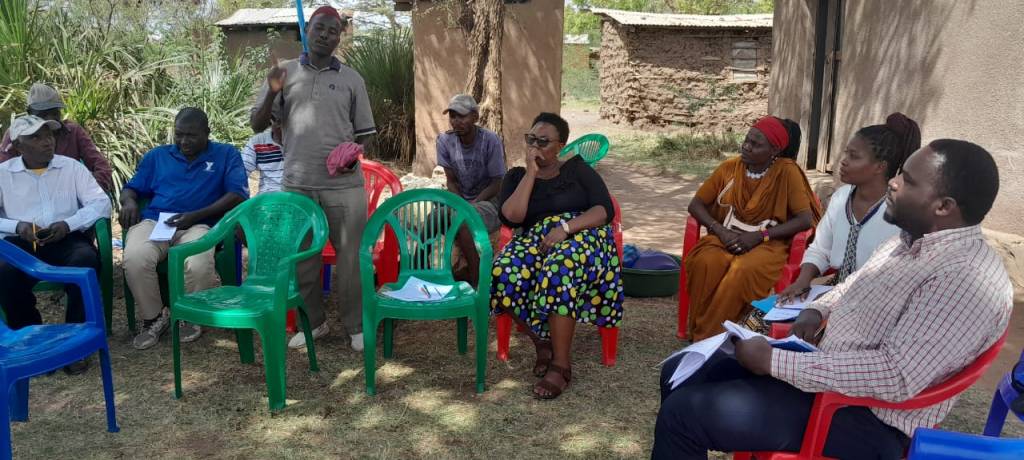
In this blog article I will briefly describe why our project works with groups, the criteria we use for group members, and the group constitution that is required for making group activities organised and successful. I also briefly touch issue of the division of labour between the groups and the project. Below you can also find a template for an agreement between a group and the project; and a template for a constitution for a group.
Why we work with groups?
There are two main reasons why we want farmers to form groups. First, it makes the workload for the project facilitators manageable, and second, working in groups creates social support that helps the farmers to perform all the tasks needed to establish a Forest Garden.
If you have 300-500 farmers participating in the project, you can’t very often see each one of them, advice them, give them the support they need to succeed in the big task of establishing a diverse Forest Garden. This may lead to many farmers fail in their efforts. Organising them into groups of 15 to 20 farmers makes it possible to meet them regularly for training sessions, discussion on the progress, any challenges they encounter etc.
In practice, as our project staff works side by side with government extension officers, we can meet each group once a week for about two hours. This has proved a very effective way of getting things done. And getting things done is rewarding to the beneficiaries. They see the progress and the difference the project makes in practice on their farms.
Groups create social efficacy and social efficacy creates individual efficacy. This means that farmers are empowered by their peers to do what needs doing to establish a Forest Garden. Some of the work such as tree nursery establishment is done together, and the first steps of learning each phase of Forest Garden establishment also happen together with others. This enables each farmer to implement what s/he has first learned in a group in his or her own farm.
Sometimes the additional work may seem too much and one may feel like giving up. However, knowing that other group members are facing the same challenges helps one to push onwards. It also forces one to perform well, as one doesn’t want to appear as a non-performer in front of one’s fellow group members (and feel ashamed). This is called social pressure, and in this context, it is a positive pressure.
The most positive side of social efficacy is the togetherness it creates, the we-spirit, the identity, “we the Forest Garden Farmers”. With a strong identity to align on, one can get more done in life.
Our criteria for group membership
Our criteria for group membership is a mixture of criteria set by the organisational strategies of the implementing organisations, international agreements such as the SDGs (Sustainable Development Goals), country strategies, donor policies, and simply the feeling that it is right to target the most needy or the most vulnerable.
Thus we have a two main rules:
- Over 50% of members in each group needs to be women
- At least 10% of them are affected by HIV/AIDS (this is a sensitive matter and sometimes difficult to ascertain).
Other criteria include: access to land, ability and commitment (up to the end) to work to establish a Forest Garden, access to water (at least limited so that small number of tree seedlings can be watered during the first two years after planting, and vegetables can be grown at least at a limited scale by using drip irrigation).
In addition, due to the high unemployment level of the youth, and the fact that most of them do not have access to land and thus can’t join the farmer groups, we have involved them in separate activities such as growing seedlings.
Agreement on project and farmer responsibilities
We strive to be completely clear about the things the project offers and what each group member needs to offer. This forms an agreement between the groups and the project. We have prepared an agreement (in English) that the group leadership and the project sign.
The need for a constitution
Constitution gives the ‘laws’ and ‘rules’ to a group. It sets the objectives of the group. It spells out the responsibilities and rights of group members, specific criteria for group members, and how to become a member. It describes how the leadership is selected and the criteria used to select them. It also describes the meetings and their frequency and purpose. Code of conduct is set by the constitution and guidance on what to do if someone misbehaves. If the group disintegrate one day, they will follow a certain organised way to do so. A constitution is also legally required to register the group in the District, and for opening a bank account, if a bank account is needed (not a necessity).
Sample constitution that you can download
We collected several samples of constitutions together and designed a template that serves the Forest Garden groups in our project. There are sections that each group can edit and rewrite based on their preferences. You are free to use this template in your project. Welcome!
 Blog for Forest Gardens in Mwanga, Tanzania
Leave a Reply